Heroines: Powerful Indian Women of Myth and History by Ira Mukhoty
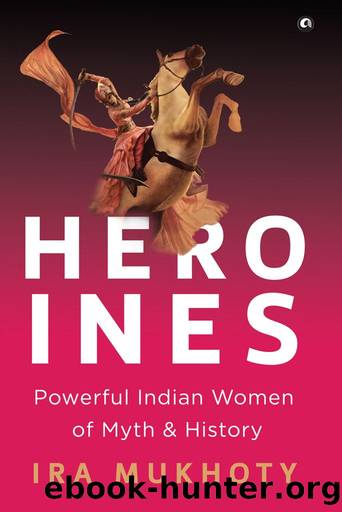
Author:Ira Mukhoty [Mukhoty, Ira]
Language: eng
Format: epub
Published: 2017-01-02T23:00:00+00:00
â¦
Jahanara first appears to us in historical records in 1631 when she is seventeen years old and her mother, Mumtaz Mahal, is dying. Shah Jahan has only been emperor for three years and the royal family has left the splendour of the court of Agra and is camped in a small town, Burhanpur, in the Deccan. Mumtaz Mahal is giving birth to her fourteenth child, but this time there is a complication. Desperate with anxiety and fear, the young princess starts distributing gems to the poor, hoping for divine help. After enduring a long and painful labour, Mumtaz Mahal dies giving birth to a girl, Gauhar Ara Begum.
Shah Jahan is inconsolable at the death of his beloved wife and his grief is lavish. He goes into mourning for two years, during which time his hair and beard turn grey. âThe pleasures of worldly rule and kingship which were mine with her by my side,â he writes, âhave now become burdens and increasingly sources of grief.â With the death of her mother Jahanara becomes, at seventeen, the first lady of the empire and head of the imperial harem. She will never marry and there will be scandalous, bazaar gossip of incest and lovers, which Italian and French adventurers will comment on with scurrilous delight.
Shah Jahan and his court returned to Agra and, for the next ten years of her life, Jahanara assumed her position as Begum Sahiba, head of the royal household. The royal residence in Agra was a monumental red sandstone fort, a walled city by the Yamuna River. Within the walls of the fort were palaces of white marble and mahals with lattice screens, water tanks, reception halls, buttresses and cupolas and with gemstone inlay work. In Agra, Jahanara was made âkeeper of the imperial sealâ and âfrom that day on the duty of affixing the great seal to the imperial edicts devolved upon her.â This was an honour never before conferred upon any imperial woman. She now had to supervise the social and financial upkeep of the harem, which was a city unto itself with hundreds of inhabitantsâAfghan, Turk, Persian, Muslim and Hindu womenâpossibly a few thousand by the time of Shah Jahan. According to the traveller François Bernier, the women âwere guarded by innumerable old crones and beardless eunuchs.â There was a cacophony of languages, which the British wife of a Muslim nobleman who lived in India in the early-nineteenth century described thus: âThe buzz of human voices, the happy playfulness of the children, the chaste singing of the domenies fill up the animated picture.â
The princesses of the house, and the wives of the king, would have received sizable allowances, all of which had to be accounted for. Jahanaraâs quarters were close to Shah Jahanâs, a sign of the enormous faith he had in her abilities. She lived close to the centre of power, in a palace with spacious rooms âdecorated with murals of flying angels, and [in which] the marble or tiled floors were covered with valuable carpets.
Download
This site does not store any files on its server. We only index and link to content provided by other sites. Please contact the content providers to delete copyright contents if any and email us, we'll remove relevant links or contents immediately.
Spell It Out by David Crystal(36189)
Life for Me Ain't Been No Crystal Stair by Susan Sheehan(35877)
The Great Music City by Andrea Baker(32901)
Cecilia; Or, Memoirs of an Heiress — Volume 1 by Fanny Burney(32684)
Cecilia; Or, Memoirs of an Heiress — Volume 2 by Fanny Burney(32042)
Cecilia; Or, Memoirs of an Heiress — Volume 3 by Fanny Burney(32027)
Professional Troublemaker by Luvvie Ajayi Jones(29726)
The Secret History by Donna Tartt(19388)
We're Going to Need More Wine by Gabrielle Union(19134)
Twilight of the Idols With the Antichrist and Ecce Homo by Friedrich Nietzsche(18724)
All the Missing Girls by Megan Miranda(16479)
Cat's cradle by Kurt Vonnegut(15490)
Pimp by Iceberg Slim(14735)
For the Love of Europe by Rick Steves(14729)
Bombshells: Glamour Girls of a Lifetime by Sullivan Steve(14172)
Norse Mythology by Gaiman Neil(13501)
Talking to Strangers by Malcolm Gladwell(13488)
Fifty Shades Freed by E L James(13318)
The Social Justice Warrior Handbook by Lisa De Pasquale(12269)
